



Study Reveals the Formation of the Earth’s Largest Oceanic Plateau by a Thermochemical Mantle Plume
A new study reveals that the Ontong Java Plateau in the western Pacific Ocean, known as the largest Oceanic Plateau on Earth, may have been formed by a thermochemical plume. The magmatism of this plateau was controlled by a mantle plume bearing both the thermal and chemical anomalies, according to thermodynamic modelling.
The study, published in Nature Geoscience on June 11th, was led by a research team from the South China Sea Institute of Oceanology, Chinese Academy of Sciences (SCSIO, CAS).
Oceanic plateaus are typical large igneous provinces located in the oceans, characterized by anomalously large areas of elevated topography and extraordinarily thick crust. They document fundamental information about magma behavior within the mantle and crust, and provide insights into how magmatism shapes the Earth’s surface and affects global environmental catastrophes.
Most oceanic plateaus are below sea level, and thus avoid subaerial erosion, making them natural laboratories to study the formation mechanism of submarine volcanism. There are two popular hypotheses on debate for the origin of oceanic plateaus: mantle plume versus seafloor spreading.
The Ontong Java Plateau, mainly emplaced during the Early Cretaceous on the Pacific Plate, is the most voluminous extant oceanic plateau on our planet. It is widely thought to result from melting induced by a hot mantle plume head. However, a purely thermal plume predicts uplift above sea level, inconsistent with the plateau’s mostly submarine emplacement.
An alternative mechanism is fast seafloor spreading inducing decompression melting of heterogeneous mantle sources with a relatively high proportion of dense fusible component. However, the radiometric ages of drilled basaltic rocks from the Ontong Java Plateau, are not close to those of the adjacent magnetic lineations, implying that the plateau was probably formed in an intraplate setting rather than near mid-ocean ridges.
In this study, the researchers use thermodynamic models to simulate the thermal and chemical state of the mantle at the time of the Ontong Java Plateau's formation under mantle plume and seafloor spreading scenarios.
The modelling results show that the seafloor spreading model requires an unreasonably high mantle potential temperature or dense fusible pyroxenite proportion. By contrast, a thermochemical plume, with a temperature anomaly of 135-200℃ and up to 13% dense fusible pyroxenite, can explain not only the spatial variations in crustal thickness and lava compositions of the Ontong Java Plateau, but also its mostly submarine emplacement. Thus, the formation of this plateau is best explained by a thermochemical mantle plume. Based on the crustal thickness and lava composition variations across the Ontong Java Plateau, a spatial evolution model of a thermochemical mantle plume head was proposed.
“In addition to the Ontong Java Plateau, many other oceanic plateaus also occur with heterogeneous mantle sources, suggesting the common involvement of thermochemical plumes for oceanic plateaus’ formation, which markedly differ from the purely thermal plume as assumed before.” Said Prof. ZHANG Jinchang, first author of the study.
A new study reveals that the Ontong Java Plateau in the western Pacific Ocean, known as the largest Oceanic Plateau on Earth, may have been formed by a thermochemical plume. The magmatism of this plateau was controlled by a mantle plume bearing both the thermal and chemical anomalies, according to thermodynamic modelling.
The study, published in Nature Geoscience on June 11th, was led by a research team from the South China Sea Institute of Oceanology, Chinese Academy of Sciences (SCSIO, CAS).
Oceanic plateaus are typical large igneous provinces located in the oceans, characterized by anomalously large areas of elevated topography and extraordinarily thick crust. They document fundamental information about magma behavior within the mantle and crust, and provide insights into how magmatism shapes the Earth’s surface and affects global environmental catastrophes.
Most oceanic plateaus are below sea level, and thus avoid subaerial erosion, making them natural laboratories to study the formation mechanism of submarine volcanism. There are two popular hypotheses on debate for the origin of oceanic plateaus: mantle plume versus seafloor spreading.
The Ontong Java Plateau, mainly emplaced during the Early Cretaceous on the Pacific Plate, is the most voluminous extant oceanic plateau on our planet. It is widely thought to result from melting induced by a hot mantle plume head. However, a purely thermal plume predicts uplift above sea level, inconsistent with the plateau’s mostly submarine emplacement.
An alternative mechanism is fast seafloor spreading inducing decompression melting of heterogeneous mantle sources with a relatively high proportion of dense fusible component. However, the radiometric ages of drilled basaltic rocks from the Ontong Java Plateau, are not close to those of the adjacent magnetic lineations, implying that the plateau was probably formed in an intraplate setting rather than near mid-ocean ridges.
In this study, the researchers use thermodynamic models to simulate the thermal and chemical state of the mantle at the time of the Ontong Java Plateau's formation under mantle plume and seafloor spreading scenarios.
The modelling results show that the seafloor spreading model requires an unreasonably high mantle potential temperature or dense fusible pyroxenite proportion. By contrast, a thermochemical plume, with a temperature anomaly of 135-200℃ and up to 13% dense fusible pyroxenite, can explain not only the spatial variations in crustal thickness and lava compositions of the Ontong Java Plateau, but also its mostly submarine emplacement. Thus, the formation of this plateau is best explained by a thermochemical mantle plume. Based on the crustal thickness and lava composition variations across the Ontong Java Plateau, a spatial evolution model of a thermochemical mantle plume head was proposed.
“In addition to the Ontong Java Plateau, many other oceanic plateaus also occur with heterogeneous mantle sources, suggesting the common involvement of thermochemical plumes for oceanic plateaus’ formation, which markedly differ from the purely thermal plume as assumed before.” Said Prof. ZHANG Jinchang, first author of the study.
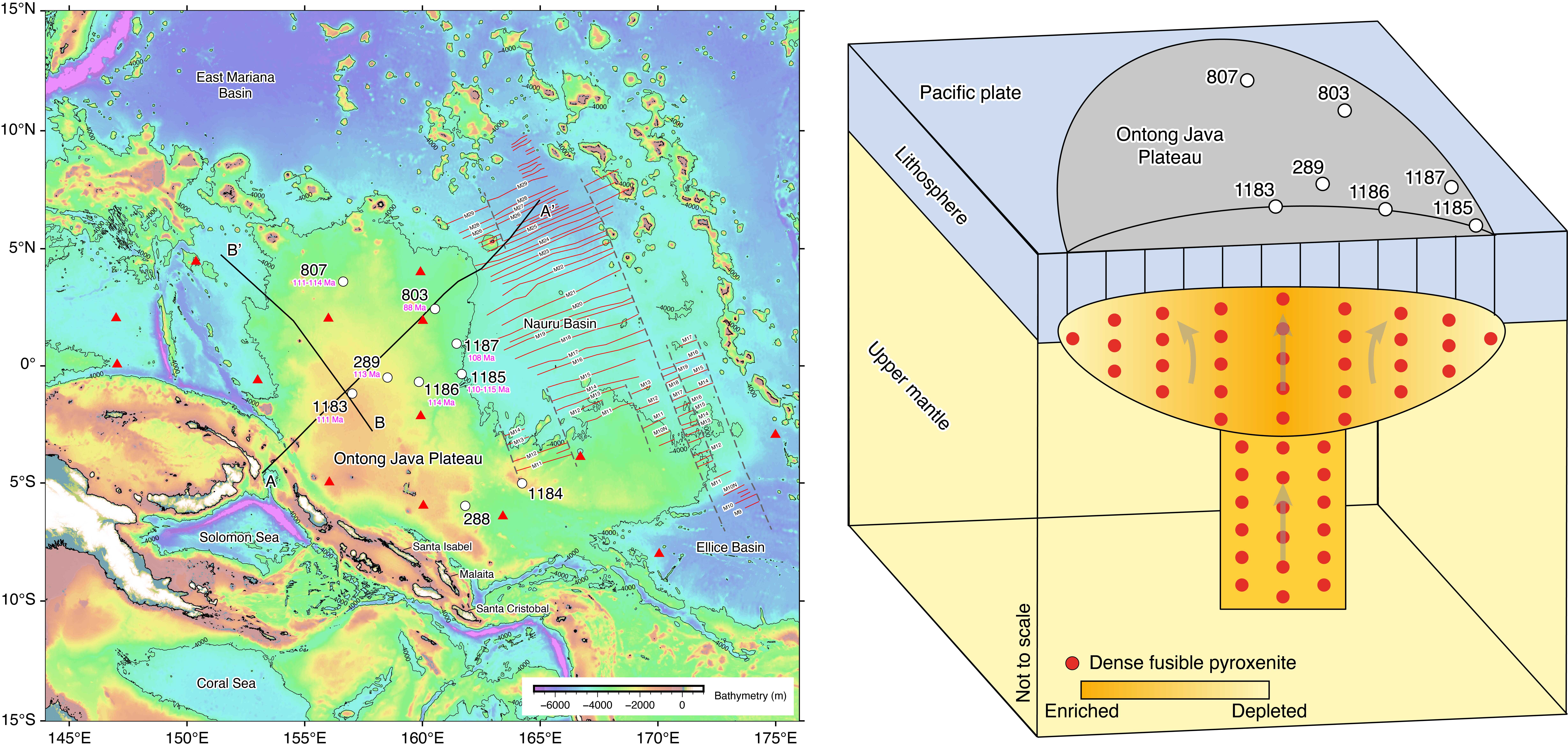
Bathymetric map of the Ontong Java Plateau and conceptual model illustrating the spread of a thermochemical plume head (Image by SCSIO, CAS)
Zhang, J., Zhang, X., Chen, S. et al. Ontong Java Plateau formed by a thermochemical mantle plume. Nature Geoscience, (2026). https://doi.org/10.1038/s41561-026-02019-9

